
People with an idea or a problem
You do not need special training. Describe what is going wrong or what you want to improve, in everyday words.

Software intake with an early check by IT
Bring IT into the request before the project starts.
Stop translating. Just type.
Start with one shared request written in plain language. Business and IT review it together, identify what needs to happen next, and estimate the effort on both sides. Leaders get a clearer picture before deciding what moves forward.
Most work goes wrong before anyone starts building — not because people cannot do the job, but because the idea was never clear enough for everyone to agree on.
One shared place to explain what you need, answer the questions, estimate the real work, decide, and hand off a plan people can follow — instead of chasing meetings, spreadsheets, Word docs, and email.
You type the idea. We handle the heavy lifting behind the scenes.
The Traditional PMO Way
Gantt charts, RACI matrices, and slide decks for a steering committee — before anyone is ready to build.
The Precision Foundry Way
We need a way for customers to reset their passwords on the mobile app.
You type the idea. We handle the heavy lifting.
A plain-language path from idea to decision to plan — without a project manager to translate it. The details that make it stick are inside the product.
Who it's for
If you can explain a problem or an idea in everyday language, you can use Precision Foundry. You do not need project-management training.
You do not need special training. Describe what is going wrong or what you want to improve, in everyday words.
Ask for a change and stay involved without learning project-management lingo.
Explain how the work affects people and day-to-day operations — in language your team already uses.
Spend less time chasing a vague ask, and more time estimating and planning from a clearer picture.
See why it matters and what it will take before you say yes, no, or not yet.
Get from idea to plan without a big project office or a binder of templates.
Help clients describe the need and leave with a clearer plan — faster.
Guided software delivery
Here is the idea. The guided path, prompts, and handoffs are waiting in the product.
Start in your own words
Describe the problem or idea like you would to a coworker. Save a draft when you are unsure.
Questions that actually help
AI helps surface the follow-ups that usually take weeks of meetings — so gaps show up early.
Effort on both sides
Technology is only half the story. See the people and process work next to the build work.
A plan the team can follow
After a decision, turn that shared understanding into work people can pick up — without rewriting everything elsewhere.
Example software request
A nonprofit wants to replace emailed client-intake PDFs with an online portal. Foundry keeps the original need beside the effort and the decision, so the delivery team does not have to reconstruct the story later.
Request
Staff need one place to receive and review submissions without losing the original business need.
Both sides of the effort
Business records 160 staff hours across 6–8 weeks. IT estimates 320 hours across 2–3 months and recommends reducing scope.
Decision
Start with staff submission and review. Move applicant self-service and text notifications to a later release.
This is an illustrative example. A person makes the final decision after both estimates are submitted.
Software lifecycle benefits
The best project management process is the one that doesn’t require a project manager to translate it. Precision Foundry is software delivery management that turns a software idea into a plan people can approve and deliver — without PMO jargon, and without treating campaigns or office work as software.
Replace weeks of back-and-forth with a guided path that gets people aligned sooner.
Size the work from a clearer request — not a rushed kickoff and a pile of assumptions.
Training, process updates, and adoption sit next to the technology work where leaders can see them.
Review why it matters and what it will take in one place — then decide.
Business and technical people share one record from the first explanation through the plan to build it.
What this product is for
Precision Foundry helps teams clarify a software idea, estimate the work, decide whether to proceed, and keep that plan connected through delivery, testing, and release. It is not built for campaigns, event planning, or everyday office tasks.
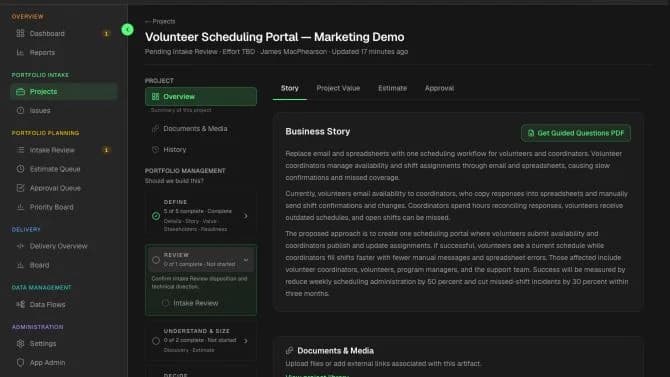
One place from the software request through release.
Turn an idea into a clear plan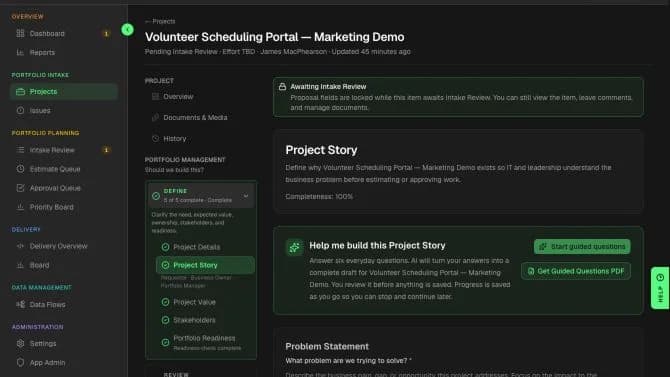
Keep the original request, agreed details, team work, testing, and release together.
Keep requests connected to delivery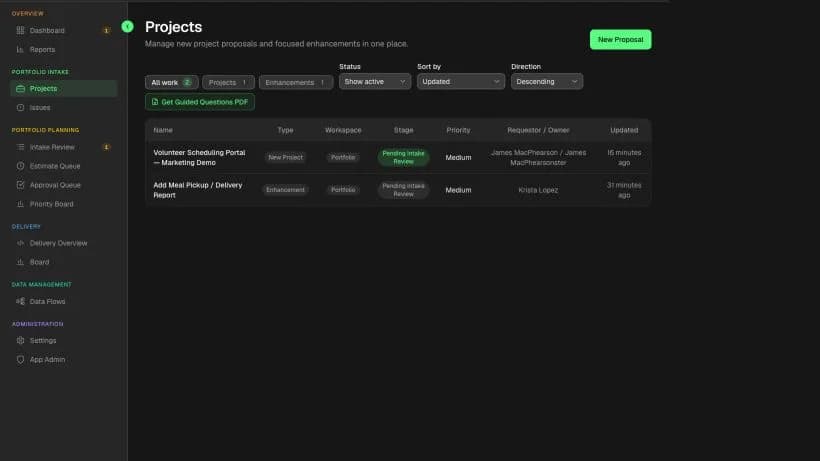
Run every software stage in one product—not an office suite.
Handle every stage in one placeCapture a complete software request in everyday language.
Start a software request in plain languageAsk project-specific questions and keep every answer reviewable.
Ask the right questions before buildingSequence the work and check readiness before the first release starts.
Plan the work before the first release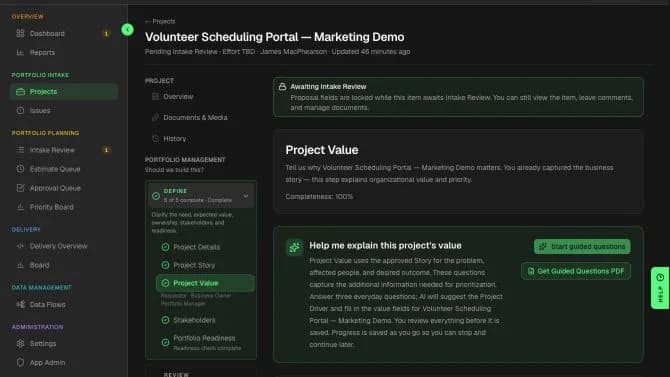
Make budget and capacity tradeoffs visible before you commit.
Decide what should move firstPlanning guides
Use these guides to clarify a request, estimate the work, prevent misunderstandings, and decide what should happen next.
Business-IT alignment
Software project intake template
Software discovery phase
Requirement drift
Intake into Jira
Anti-PMO playbook
From the blog
Three recent notes on making software intake and delivery clearer without adding more process jargon.
Anti-PMO
Sooner or later, most teams watch a steering pack stamp Stage 2 and call it a decision. The gate was real. The first-release result was not written.
project phase gate approval decisionNo Jargon
I’ve survived executive no conversations by refusing to make them personal. The safe no is evidence, alternatives, and a named tradeoff.
diplomatic scripts for telling a VP no to a projectAnti-PMO
We have all watched kickoffs end with a photographed wall and call it a backlog. A leftover sticky note is still unfinished intake.
a kickoff parking lot is not a software backlogHonest fit
Precision Foundry is not a good fit for a marketing campaign, an event, or a standard office workflow. Use a general team tracker for that work. Foundry is for software change that needs a shared plan before anyone builds.
Use Foundry
Specify and deliver software—new systems, enhancements, integrations, and the business case that has to stand behind them.
Use a team tracker
Assign owners and dates for campaigns, events, and recurring office work without writing epics, stories, and acceptance criteria.
Software delivery management, end to end
Precision Foundry manages software change: business and IT clarify the request, estimate both sides, decide whether to proceed, and keep that plan connected through delivery, testing, and release. Jira, Asana, monday.com, and Leantime serve broader project or work-management jobs. Another tracker is optional.
Jira tracks defined work on boards and sprints. Foundry turns an unclear business request into approved, estimated, delivery-ready software—and keeps the original need connected through testing and release.
Precision Foundry vs JiraAsana is work management—tasks, projects, goals, and request forms. Foundry is software change through testing and release, not a campaign tracker.
Precision Foundry vs Asanamonday.com is a Work OS for every department, including monday dev. Foundry is built only for software change through testing and release—not another customizable board.
Precision Foundry vs monday.comLess time in meetings and spreadsheets. More clarity before anyone builds.
Optional cookies
We use optional technologies only with your choice. Strictly necessary cookies for sign-in and security always run. Cookie Policy